Labels

Beer (13) Bread (1) Burger (1) Cheese (6) Chinese (2) Coffee (4) Cracker (1) Deli Counter (2) Deli Meats (5) Dessert (4) Drinks (5) Fruits (4) Hot Sauce (1) Meat (7) Middle Eastern (3) Noodles (3) Oils (2) Pickles (1) Seafood (10) Snacks (2) Spices (2) Spirits (2) St. Lawrence Market (9) Vegetables (5) Wine (2)

Thursday, February 20, 2014

Day 87: Grapefruit


Through the deep and dark months of the winter, there is, surprisingly an amazing fruit that comes into season: citrus! I actually had no idea that citrus are in season in late February to March. I assumed it was a summer fruit like everything else.

For me, as a kid growing up on an orchard, the summer and fall months were marked by the changing of the fruit. Cherries, then school ended, then strawberries, then pears, then school returned, then apples, then pumpkins, then Halloween. This mattered to us kids for two reasons. First, we survived off of eating fresh fruit, much to the annoyance of the farmer (and his vicious man-eating dog - more on that in another post), and to the disapproval of our parents because they rightfully assumed that eating dozens of fruits in one sitting would probably spoil your dinner. And secondly, picking fruit was our main source of income - there was only one paperoute, and Dylan, the eager entrepreneur who lived 5 doors down from me, had that sweet gig locked up as long as I'd ever known about the route. So what's a kid to do if they wanted to make an honest buck back in the day?

But I digress. Citrus. I never watched citrus season change, because of course in Nova Scotia, you didn't grow citrus. That is, until the other day, when our Grocery Gateway order came in, and they substituted one fruit with a grapefruit.

I'll admit, grapefruit was never my favourite fruit. As a kid, I would sprinkle copious quantities of sugar on top of it, and spoon out the little segments one by one. At the very bottom, once all the segments were removed, I'd pretend it was a bottomless soup bowl, and spoon out the now oversweetened juice, which seemed to magically fill my spoon with liquid every time I pressed it to the bottom of the "bowl". So when I got that Grocery Gateway shipment the other day, I wasn't thrilled. But then I cut open that bad boy.

The flavour is crystal clean. Sour to start, and finishing with a sweet coda. The texture - both crunchy and juicy with little vesicles exploding in your mouth. You get little flecks of bitterness from the white membrane, which is both painful and pleasurable. What you realize is that the fresher it is, the sweeter, juicier, crispier, and citrus-like it is.

My favourite way to prepare them is to skin it. Just lop off the top and the bottom, stand it upright, and then cut off the skin. Once it's naked, I cut it roughly along the natural segments. The fancy way to prepare it would be to, instead of cutting roughly along the segments, cut out the segments, leaving the white membrane in tact. You can do the entire grapefruit, and then at the end, squeeze the juice from the membrane into the bowl. (there's actually a fancy term for this technique, and it's called "supreming" the grapefruit... well well...)

You can also dehydrate them. I have an actual dehydrating machine (not that I'm trying to brag but I sort of am...), but you can just bake it on a rack over a baking sheet at 170F for 6-7 hours. It makes a nice garnish and snack too.

Another thing you can do which I've heard of, but never tried, is to submerge segments in a neutral oil, like canola, stirring until segments break down into individual vesicles (vesicles are the little juice-packed sacs that constitute the grapefruit). I don't know exactly what you would do with this, but I imagine you can use this in salads, or dressings or add it to fancy drinks.

Conclusion: get them now. Season ends in mid-March.

On grapefruits
Grapefruits are actually a natural hybrid of a sweet orange and pomelo. A pomelo is massive citrus, which many westerners, but very popular in asia. Apparently, back long time ago, grapefruits were white in colour, but now, they've been cultivated to be red.

Florida is the world's leading producer of grapefruit (these grapefruits came from there).

Saturday, October 19, 2013

Day 87: Skate Wings

Skate. Yes, the fish that looks like a stingray, and you're eating the wing. Not an easy fish to find at stores in Toronto, and you have to be lucky to find it at a store because it depends on when the fishmonger gets a shipment in, but I was lucky to find it at St. Lawrence Market. The price is about $8 for a 1lb wing and each wing is enough for 2 adults because there is surprisingly a lot of meat there.

The texture is the most curious part - it's firm, sort of slippery and has a noodly sort of feel to it. The skin is fatty and the flavour of the meat is almost like scallops. In fact, sometimes they are marketed as "imitation scallop" You've got cartilage in between the top and bottom of the wing and the meat scrapes easily off of the cartilage with just a fork.

One of my favourite ways to enjoy skate is the Malaysian way, because skate is a common Malaysian hawker food (i.e. from a street vendor), and the flavour comes from banana leaves, chili powder/paste, and plenty of ginger and galangal.  But in the picture above, I basically pan fried it (dry with paper towel, then add salt/pepper, then fry in butter) and finished it in a hot oven. I added caper berries and browned butter on top - browned butter is basically butter which is cooked in a pan to the point that it's brown, giving it a nutty aroma. It may take a bit of practice to get the browned butter just right.

On Skate (from Monterey Bay and Encyclopaedia Britannica)
Skates are cartilaginous bottom-dwelling fish, of the superorder "ray". Previously discarded as "trash fish" and a nuisance fish, skate has become an increasingly important fishery.

According to the Monterey Bay Seafood Watch, Skate is recommended to be avoided from a conservation perspective because several skate species in the Northeast are overfished or in serious decline. Skates, like their close relatives, the sharks, are highly vulnerable to overfishing since they grow slowly and are long-lived.

Wednesday, July 24, 2013

Day 86: Guanciale

Guanciale (pronounced gwan-CHA-lay) is a bacon that's made from pork cheeks. Cheeks are wonderful parts of animals that are totally underused. They have lots of fat, lots of texture, and they can be cheap. Think Halibut cheeks or Barbacoa. Just little flecks of Guanciale are nice in scrambled egg or on a salad, and it can be amazing with corn. It's the best way to go for Spaghetti Carbonera (the pasta that has an egg-based white sauce and bacon). In Southern States, they smoke the cheeks (guanciale is unsmoked)  and call this "hog jowl" and used in dishes like collard greens. It can be substituted with Pancetta, but the fattiness is a different taste.

The texture is nice and chewy, but you really get that genuine dark meat and salt flavour in every bite. In the picture, you see lots of meat, but much of it below the picture is actually super fatty. And the texture on the edges, if you cook it right, gets nice and crispy. I prefer it cubed, because you get the chewiness of it, but thin like this is good and a little goes a lot further. I got this from Brickworks Farmers Market. At  a whopping $50/lb, this is something of a treat. A little $10 or $15 piece will flavour a good pound of pasta. To put this in perspective, your regular breakfast bacon usually retails at around $3-$5/lb. Pancetta is a bit more than this. Something like Iberian Ham de Bellota can run you up to $600/lb, so with that in mind, $50 is a deal, right?

On guanciale
Guanciale is Italian cured pork cheek or jowl. It's traditionally used in classic pastas, like spaghetti all carbonara and bucatini all'amatriciana. Because it's largely fat, guanciale has a more seductive pork flavor and delicate texture than cured meat that comes from the belly (like pancetta, which is a common substitute, though the flavor isn't the same).

To make guanciale, you rub pork cheeks with some combination of salt, sugar, pepper, herbs and spices and then air dry them for several weeks.

Saturday, June 22, 2013

Day 85: Chaunsa Mangoes - The King of the Mangoes

The King of the Mangoes. I didn't come up with the name. That's just what it's called! It's also known as the "Chaunsa" mango and it is mainly cultivated in India and Pakistan. It is is in season between June and mid-August, and you can buy them right now in little India.

The sign of them read "Very Sweet" in a black marker. They cost over $2 each, and they're smaller than those massive red mangoes you get all year round. But the taste. Oh the taste. If you've ever been or lived in Southeast Asia, this is what you're used to. Sweet flavour, cold slippery texture, not fibrous at all, and pumped full of mangoey (is that even a word?) flavour.

In the Philippines, the most common mango is the ataulfo mango, aka Manila mango, and they are actually grown in Mexico, so we can get them here in Canada when they are in season (April - October). And they're probably not as good here in Canada as they are if you get them fresh in the Philippines or Mexico, but they're pretty damn awesome. Right now in Little India, you can get them for 50 cents each, so about 75% less than the Chaunsa mango.

But more common in your average grocery store is the Tommy Atkins mango, which aren't very sweet and the flesh is harder, drier, and more fibrous, but definitely passable given our options in Canada. But they ship well, have long shelf lives, and don't bruise as easily. Apparenlty 80% of mangoes in the UK and US are these. For some reason, I always call these "Mexican Mangoes", to distinguish them from "Filipino Mangoes" although I can't find any reference to this name on internet so I don't know if I made up that name or I saw it somewhere.

Ataulfo mango vs. Tommy Atkins
Why are they Chaunsa mangoes so expensive vs. Ataulfo or Tommy Atkins? If you are conscious of carbon footprint, cover your ears. The short answer is that I bet that they are air freighted in, and that adds a few bucks per pound. But why are these air freighted in? I'm about to launch into a bit of an economics speculation, so you can skip this section below, but absolutely economics matters in food. Keep in mind that one of secrets to any fruit is the ripening process. As you may know, a fruit which is ripened on the tree or vine, will always have more natural and delicious sugars. Easy for a grocer in the Philippines to access these fruits because the grower is a few miles away, but here in frosty Canada - how do you get these tree ripened fruits? Put yourself in the position of the grocer. First, you can get them from a Canadian hot house, think about tomatoes, so you can get them vine ripened even in the winter. Yum. Alternatively, you can find a distributor who brings them in from Latin America, so typically they have to be picked a few weeks before they're ripened and allowed to ripen on the container over where a distributor would ship them to you. These typically won't taste nearly as good and sometimes the transportation process bruises the fruit and it gets sensitive to shelf life. There's always the option of preserved vegetables, and if you think about it, part of the great expansion in Dutch trade in the 17th century was because of the invention of a process of preserving fish and specialized ships that allowed this to happen (called "gibbing" if you're ever interested). So preservation is an option. But there is a change in flavour. Finally, you could air freight them in. Air freight comes over in 24-48 hours I believe, so they can be tree ripened in Pakistan, and at your grocery counter 24 hours later. But air freight is much more costly than shipping by container because of the packages are harder to handle (vs. shipping containers which can be picked right off a boat and directly loaded onto a truck), the fuel cost of lifting an aircraft thousands of feet above ground, and you don't get scale because you're not bringing in thousands of grocery stores worth. It might be just for you and three other stores. And air freight can be shipped right to your grocery store or a storage place near the airport, so there's all those costs of getting to the airport, picking up a small amount, and then bringing them to your doorstep within a few hours. It could be handled by a distributor, or who knows, each of them could do it on their own, and the grocery store owner could drive to the airport on the way onto work, whatever, the point is that air freight adds a few extra bucks per pound (hence $2 per mango). This is neither here nor there. Sometimes it's the only alternative for getting amazing tasting mangoes in Canada.

Saturday, June 15, 2013

Day 84: Mussels

A mussel dipped in a bit of butter. Sprinkled with a smoky hot sauce. Some crusty bread on the side. Awesome. What I love most, though, is sipping on wine while eating mussels, because you get that oceany flavour that comes right through.

It's June. So what? When is a good season for mussels? That's a hard question to answer. The received wisdom is that you should eat them in the months with the letter "R" in them (i.e. September - April), but I think that they are good all year round. I don't know how scientific the "R" month strategy is, but one reason is that the mussels spawn in the summer, so the meat is a little bit smaller. Sometimes you'll get  a batch and they are really thin, and that's because they just released all of their "goods". The other reason is safety, because if you're not dealing with a good fisherman, sure,  the water is a bit warmer and so bacteria can grow if they aren't stored and handled properly.

The mussels here were from St. Lawrence Market, and they cost $2.99/lb. Typically, I can eat 1 lb myself for an appetizer, or it's a side dish, half a pound per adult is okay.

The quickest way to cook them at home is just to fry up some onions, garlic, carrot, celery, until soft, then add the mussels and some liquid (e.g. broth, white wine, water, clamato) and cook until the mussels open which is anywhere from 3 to 6 minutes. Save those juices at the bottom of the pan, I call that the nectar, and just add parsley into it at the end and pour it all on top of the mussels.

Throw out the mussels that don't open, because they're dead and you have no idea how long they've been dead.  In the photo above, I made a tomato stew (canned tomatoes, clam juice, onions, garlic, oregano), and then added the mussels at the last minute and I ate it with baguette cut into triangular pieces - that way you get lots of soft surface area to soak up the liquids with. I've heard that you shouldn't serve them to kids under 5.

Sometimes you need to debeard them, but I've found that in Toronto, they generally take out the beards for you. Mussels with beards in seem to be able to be stored alive for longer.

On Mussels (facts come from Wikipedia)
Mussel is the common name used for members of several families of clams or bivalvia mollusca. Most of us are used to seeing the "blue mussel" here in North America. This is interesting - 80% of cultured mussels are produced in Prince Edward Island. When I was in Vancouver, though, I noticed that there was a lot of mussels from Washington states, in fact an estimated 2.9M pounds of mussels were harvested in 2010 valuing roughly $4.3M.

Mussels can be smoked, boiled, steamed, roasted, barbecued or fried in butter or vegetable oil. You can get smoked canned mussels at most grocery stores, in the same area as canned tuna, and you can put them right on crackers.

In Belgium, the Netherlands, and France, mussels are often consumed with french fries ("moules-frites") or bread.

As opposed to the Blue Mussel, New Zealand green lipped mussels can be found in restaurant here in Canada but almost always in their previously frozen form and on the half shell. Why would someone use a frozen mussel? My guess is that they are safer to handle than live mussels, especially if you're not selling a whole lot of them in your restaurant.  The meat is quite large, but chewier, because they were previously frozen.

Mussels are a high protein food source. Their low fat content makes them potentially healthier than other protein sources, such as beef, which can contain a lot of saturated fat. Mussels are also low in calories. Mussels are also an excellent source of vitamin B12 and selenium - Vitamin B12 is important in the functioning of metabolism processes and a deficiency can cause fatigue and depression, as well as other symptoms. Mussels are also good sources of other B vitamins (particularly folate), phosphorus, manganese and zinc. Mussels are a very good source of omega-3 fatty acids and are considered an excellent seafood choice.

Wednesday, May 29, 2013

Day 83: La Tomme de Haute-Richelieu

This may sound childish, but the reason I decided to get this cheese was because I was recently watching Ratatouille, and at one point, after finding some leftover cheese, Remy (the main character) looks at his brother, Emile, and goes, "Do you know what this is? It's not just any cheese, it's La Tomme de Pays! Gusteau loves this stuff!"

I ended up getting another cheese, and before I go into what I actually got, what is La Tomme de Chevre de Pays and why was little Remy waxing philosophical about it? And why was it so hard for me to find it?

TommeTomme-style cheeses are the ones with a grey-brown rind, making it look sort of 'rustic' or 'weathered' and I typically think of them having a soft and creamy texture - think brie or camembert. This is not the actual definition, but since I'm more layman than cheesemonger, let's just call this a working definition because it'll help you out 90% of the time.

Chevre - means Goat in French, so it's made of goat blood. Just kidding. It's made with goat milk (obviously).

De pays.- means "from country" in French. So typically, a tomme would use the region after its name (e.g. "Tomme de Savoie" or "Tomme de Beaujolais") and since 'Pays' translates to 'Country', Remy was looking for a Tomme cheese "from country", which as you can see, doesn't make sense and so that might also explain the weird looks like received when I was asking the cheesemongers if they had "Tomme de Chevre de Pays" because that doesn't exist!

I ended up getting something called "La Tomme de Richelieu". It's a tomme from Quebec and it had that  milky, farm, nutty flavour with a soft melt-in-your mouth texture. The rind was really sticky and strong smelling so that threw me off at first. Not sure if it was because I had it in my bag for awhile. The price came to $55/kg. (for perspective, cheddar cheese is typically something like $10/kg).

On La Tomme de Richelieu

Created 12 years ago by Fritz Kaiser, Le Tomme Haut Richelieu was an invention of necessity. The fromagerie had received more goat's milk than it needed to make its soft cheese Chevrochon. Wanting to preserve the milk by making a cheese that would have a longer shelf life, they made a goat's milk version of their semi-soft cow's milk cheese.


Day 82: Fiddleheads

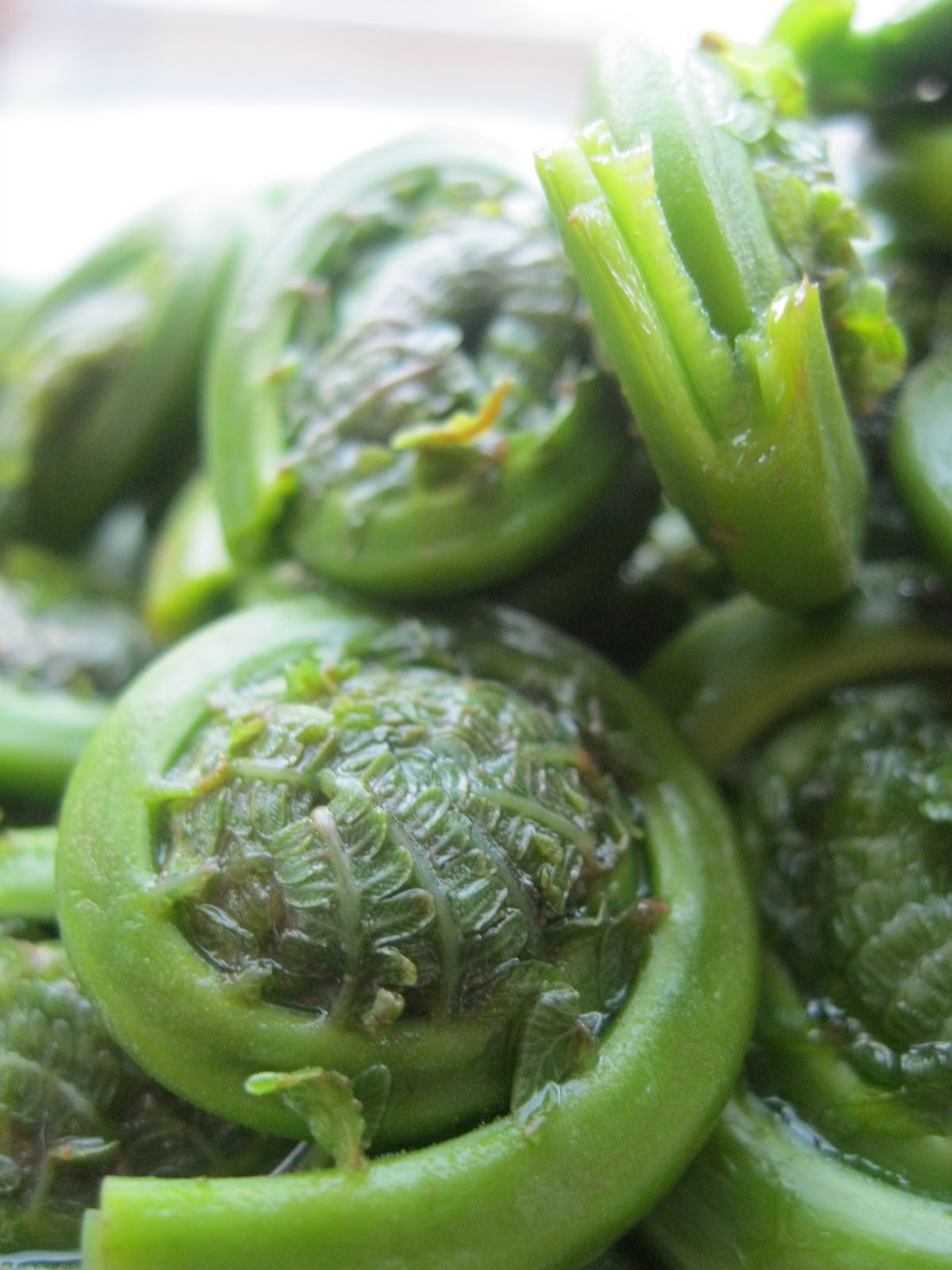
If you've been in grocery stores this week, you may have noticed that fiddleheads are in season. For some reason, the grocer at St. Lawrence Market had them floating in water, which made it look fresher. The price was $6.99/lb.

You can blanch, steam, or stir fry them. Blanching and stir frying is nice, because it seals in the colour. But stir frying is more practical though. We put in some fried onions and garlic, and then a little bit of hot mustard (the mustard came from Caplansky Deli and that stuff is awesome). You can add lemon.

You may want to cook them for quite a while (over 10 minutes) for food safety reasons. Cleaning them is a bit of a hassle, because you need to remove these little brown stuff on the outside and you have to chop off the woody part of the stem.

We ate this quite a bit as a kid (apparently there's a town in NB that claims to be the fiddlehead capital of the world?). The flavour is like a subtle asparagus and the texture is curious -  fibrous and chewy. It's a nice treat in the middle of the week, but it is a bit of work to prepare, and the cooking time is relatively longer.

On Fiddleheads (from wikipedia): 

'Fiddleheads' or 'Fiddlehead greens' are the furled fronds of a young fern,harvested for use as a vegetable. Left on the plant, each fiddlehead would unroll into a new frond.

They have antioxidant activity, are a source of omega-3 and omega-6 fatty acids, and are high in iron and fibre. It is also called a crozier, after the curved staff used by bishops, which has its origins in the shepherd's crook.

They  have been part of traditional diets in much of Northern France since the beginning of the Middle Ages, Asia (India, Korean, Chinese, Indonesia) as well as among Native Americans for centuries. They  are a traditional dish of northern New England (especially Maine) in the United States, and of Quebec, Ontario and the Maritimes in Canada.

Fiddleheads are available in the market for only a few weeks in springtime.

Saturday, June 23, 2012

Day 81: Strawberries

Strawberries are the epitome of that childlike mindset that if it's tasty, it can't possibly be good for you. Because strawberries are yummy, but people used to tell me that they weren't as healthy as, say, brussell sprouts. Based on my own research, in fact, strawberries have an exceptional amount of antioxidants. In any case, no one eats strawberries for antioxidants, nor should you because that takes away from the fun. I also hear about strawberries as an example of indulgence that contributes to global harm. Has anyone ever complained to you, in the context of a world of consumerism leading to excessive transportation and global warming externalities, that "as a society, we require things like strawberries in the wintertime". So a bad rep for these fruits. But point taken, strawberries in the wintertime aren't that tasty (I think that's the point of these anti-consumerism activists, right?)

Strawberries have been in season for a few weeks already, and the season is going to stretch maybe into mid July if we're lucky. For the rest of the year, we get them from places like California. They get picked early on, ripen in trucks, and then arrive in Ontario. The species are genetically selected for size, shininess and to withstand the harsh treck diagonally across the continent. But when they're in season, they picked at their prime, ripening on the bush and letting the sugars all blossom naturally. The best strawberries are the small ones, slightly darker in colour, not shiny, but fresh because that's where all the sugar comes from. The big fat shiny ones are watery in their juices, slightly sour, and one dimensional in flavour. They're about $5 per quart (about 20 strawberries) or sometimes $6 per quart for smaller strawberries, but for smaller ones, you get more because even though it's still a quart, you can fit more strawberries in them because they're smaller and they fill more of the empty spaces. And the smaller ones are sometimes better. I've seen these smaller ones called "field strawberries" here... wondering if they're actually a different variety?

You usually should wash them before eating them because of the pesticides, but eating a few unwashed won't kill you, unless you are a bug.

On Strawberries (from wikipedia)
The strawberry is, in technical terms, an aggregate accessory fruit, meaning that the fleshy part is derived not from the plant's ovaries but from the "receptacle" that holds the ovaries. Each apparent "seed" (achene) on the outside of the fruit is actually one of the ovaries of the flower, with a seed inside it. In both culinary and botanical terms, the entire structure is considered a fruit.

The first garden strawberry was grown in France during the late 18th century. Prior to this, wild strawberries and cultivated selections from wild strawberry species were the common source for the fruit. Other names for wild strawberries include  Alpine Strawberry, Fraises des Bois, Wild Strawberry, and European Strawberry.

Day 80: Shell Peas


Shelling peas are in season now and you can get them at farmer's markets or grocery stores. They are these fat peas that you peel by hand and eat raw. This was a sort of critical point in the summer for me as a kid because that's when summer vacation started. As a kid, I used to hide in the neighbour's garden (these plant grew tall enough that a kid can effectively hide in them) and just eat and eat and eat, and throw the empty shells on the ground. The benefit was the oxygen from the mass of leaves combined with the shade, made for an escape from the summer heat. Some of them are super sweet, some of them a bit more neutral. They're a bit crunchy and the process of shelling, eating, shelling, eating... just the repetitiveness of it is meditating. It's a bit like eating edamame, but not cooked and no salt, and you eat them immediately after being picked.

I got the ones in the picture from a farmer's market, a quart of them (~50 peas in total) was $2.50 and it took me about 20 minutes to eat the whole thing because I didn't even realize I was eating them so fast until I looked back into the bag and realized it was all just empty shells. The best way to eat them (in private of course), it to crack open the shell and then dig your mouth into them and eat all of the seeds in one gulp. A close-second is to pick them out one by one. Either way, enjoy! Third best way is to collect all the seeds, and cook them then put them into salads, pasta, or whatever.

Monday, May 21, 2012

Day 79: Soft Shell Crab


Doesn't that photo look appetizing? About as appetizing as biting into a fried spider.

Unfortunately, this one was a bit old and had probably been sitting around for too long. So I'll have to try again at a later time. But the meat was tasty - tastes like sweet crab and the shell and little legs are pretty much, soft, which should have contasted with the crunchy batter had my dish been fresh. But loads of mayonnaise pretty much hides everything... oh wait, sorry it doesn't.

On Soft Shell Crabs: Soft-shell crab is a culinary term for crabs which have recently molted their old exoskeleton and are still soft. In the United States, the main species is the "blue crab", which appears in markets from April to September. In Japan, various species are used to make sushi, including the Japanese blue crab or the shore swimming crab. In Italy, the soft-shell of the common Mediterranean crab is a delicacy typical.

Day 78: Collard Greens

Collard Greens are maybe a kid's worst dream. Green (very green), potentially brown, they're mushy, they're  bitter, and did I say it before, oh, they're green. But I had these bad boys at a show in New Orleans and they were pretty damn good. Too brown for my likes, but that comes with the steam table I guess.

I usually prefer them, though cooked with something smoked and fatty, like bacon or ham hock.

On collard greens

Collard greens are various loose-leafed vegetables, from the same family as kale, spring greens, cabbage and broccoli. The plant is grown mainly in Brazil, Portugal, the southern United States, many parts of Africa, Montenegro, Spain and in India. The name "collard" is a shortened form of the word "colewort" (cabbage plant).


Collard greens are a staple vegetable of Southern U.S. cuisine. They are often prepared with other similar green leaf vegetables, such as kale, turnip greens, spinach, and mustard greens in "mixed greens". Typical seasonings when cooking collards can consist of smoked and salted meats (ham hocks, smoked turkey drumsticks, pork neckbones, fatback or other fatty meat).

Sunday, May 20, 2012

Day 77: Cheese Mankeesh


Cheese Mankeesh: A soft bread  that bends and folds as soft as a piece of pita bread, but with a crispiness of being straight from a hot oven. It tastes a bit like a nice, buttery pizza. One of my favorite $3.99 snacks (incl tax!) on my way home from work at Paramount Middle Eastern Restaurant.
On Mankeesh (from wikipedia): Manakish, also manaqish, manaeesh or manakeesh (Arabic: manāqīsh) is a popular middle eastern food consisting of dough topped with thyme, cheese, or ground meat. Similar to a pizza, it can be sliced or folded, and it can either be served for breakfast or lunch. The word manaqish is the plural of the Arabic word manqūshah, meaning that after the dough has been rolled flat, it is pressed by the fingertips to create little dips for the topping to lie in.
Traditionally, one would bake dough in a communal oven in the morning, to provide the family with their daily bread needs, and would prepare smaller portions of dough with different toppings for breakfast at this time.


Day 76: Taylor Fladgates Late Bottle Vintage Port

One of the most incredible drinks to have at the end of a meal, that warms up the tummy, makes your head slightly fuzzy, but is nice and sweet on the tongue, and can go with cakes or creams and cuts right through that fat. Probably doesn't eliminate the fat, but at the least, makes you feel less heavy.

As the reader may know, port is a sweet dessert wine. But this bottle had an interesting mushroomyness to it. Its nice and warm on the back of the throat, and an almost instantaneous buzz as the warm fumes rise straight to your brain. At less than $20 a bottle, a real steal, especially considering in about 3 years when it gets to that magical 10 year mark, it would be double the price.

On Port:

Port wine (also known as Vinho do Porto, Porto, and often simply port) is a Portuguese fortified wine produced exclusively in the Douro Valley in the northern provinces of Portugal. It is typically a sweet, red wine, often served as a dessert wine.

Fortified wines in the style of port are also produced outside Portugal, most notably in Australia, South Africa, Canada, India, Argentina, and the United States. Under European Union Protected Designation of Origin guidelines, only the product from Portugal may be labelled as port or Porto.

Port is produced from grapes and the wine produced is then fortified by the addition of a neutral grape spirit known as aguardente in order to stop the fermentation, leaving residual sugar in the wine, and to boost the alcohol content. The wine is then stored and aged, often in barrels stored in a cave before being bottled.

The wine received its name, "port", in the latter half of the 17th century from the seaport city of Porto at the mouth of the Douro River, where much of the product was brought to market or for export to other countries in Europe.

Late Bottled Vintage (this particular bottle), as the name suggests, is bottled later, remaining in wood between four and six years. This is in contrast to Vintage Port which is kept in wood for only twenty months or so before being transferred to the bottle where it will continue to age. Therefore, Late Bottle Vintage was developed as a high quality but more affordable and immediately drinkable alternative to Vintage port to be enjoyed by the glass on everyday occasions. Late Bottle Vintage is the most popular premium Port style in both England and Canada,

On Taylor Fladgate:

Taylor, Fladgate, & Yeatman (often simply Taylor Fladgate) is one of the largest port wine houses. Founded in 1692 in Vila Nova de Gaia, Portugal by Job Bearsley, becoming Taylor, Fladgate, & Yeatman when Joseph Taylor, John Alexander Fladgate and Morgan Yeatman formed a partnership in 1838, it is also one of the oldest. The house ships almost all types of port including vintage, tawny, ruby, late-bottled vintage, and white. The house invented the style of late-bottled vintage port. Taylor Fladgate's vintage ports are some of the most sought-after and expensive ports in the world.

Thursday, April 26, 2012

Day 75: Mezzo Mondo Wine


When I look for a nice, simple, sipping wine at an amazing price, I almost always go for this one - MezzoMondo brand Negroamaro Salento. You're not going to find anything bold or loud. You may even find it a little too tanic. But for under $8 a bottle, all that doesn't even cross your mind because it's just so far off the radar.

Why do I like cheap wines? Because it plays second or third fiddle to the conversation, it's something you don't even notice - it's neither fantastic nor terrible. But THAT'S the way I likkke it baby.

On Negroamaro
Negroamaro, also Negro amaro, is a red wine grape variety native to southern Italy. It is grown almost exclusively in Puglia and particularly in Salento, the peninsula which can be visualised as the “heel” of Italy. The grape can produce wines very deep in color. Wines made from Negroamaro tend to be very rustic in character, combining perfume with an earthy bitterness.

Although 100% varietal wines are produced, Negroamaro is more commonly used as the dominant component of a blend including such varieties as Malvasia Nera, Sangiovese or Montepulciano.

Sunday, April 8, 2012

Day 74: Jaipur India Pale Ale

I am a sucker for a good India Pale Ale (IPA). This really is a well balanced one - the fruits, hops, bitter, sweet... nothing overpowering. Grapefruit flavours, a hoppiness that doesn't get you high, but a round bitterness that hugs your cheeks. A caramel sort of appears at the end, like a ghost. The price is a touch higher than Ontario craft IPAs, something like $4.50 for a 500mL bottle. But well worth it.

On Thornbridge Breweries:
With over 200 industry and consumer awards over the past 7 years their beer continues to highlight the importance of traditional ale in the British pub. Thornbridge branded beers were first brewed in early 2005 in the UK and now operate from two brewery sites.

On Jaipur IPA:
From a rought count on the website, this beer has won 88 of the 200 awards. The website describes it as: "A citrus dominated India Pale Ale, its immediate impression is soft and smooth yet builds to a crescendo of massive hoppiness accentuated by honey. An enduring, bitter finish."

On India Pale Ales (from wikipedia and about.com)
IPA descends from the earliest pale ales of the 14th century. A pale ale is an ale which has been brewed from pale malt.

But in the early 1700s Britain had a problem. Troops and British citizens living in India as part of the colonial rule did not have access to good British ale and any attempts to ship the malt British ales to them resulted in spoilage. India Pale Ale, or IPA, was the solution. The generous amount of hops in this brew protected it from the heat and motion of the British sailing ships of the day.

IPA could have faded into history but a fateful shipwreck in 1827 wrecked and damaged some of the casks of IPA on board. The casks were sold there in England and the unusually hoppy ale was a big hit. Soon the new brew was in demand and a new style.

Lots of pale ale and a bit of crystal malt give this styles enough malt sweetness to stand up to the demanding hops. A good IPA will have a pleasantly hoppy aroma. The flavor should be equally hoppy with plenty of balancing malty sweetness.The overwhelming hops flavor of this brew make it a tough beer to pair foods with. Almost any sort of spicing clashes with the hoppy character. Roasted meats can work with a subtle barbecue sauce. Many prefer this beer alone so as to savor the hops.

Tuesday, March 27, 2012

Day 73: Kettle Corn (Popcorn with salt and sugar)

Something so simple, but something so amazing is popcorn. And we're not talking about microwaveable variety with plastic butter an a million carcinogens.

I like to use air popper at home ($12 at Walmart), which is nice because there's no clean up, and no need to monitor is as it goes. And it comes out nice and fluffy. And it's cheap. The same $1 bag of microwaveable popcorn is probably ~5 cents if you pop it on your own (I don't buy name brand popcorn - I generally try to avoid name brand anything for that matter). And if you don't feel like eating a whole bag, you can only pop a little bit. And you don't end up getting a burned by steaming air when you open it. So many reasons to pop it yourself.

I like to add butter, salt (ground up in a mortar and pestle), and some sugar. Why grind up the salt? Because it sticks better to the popcorn. The same technique can be used for fries or chips.

The best part is mopping up the butter on the bottom of the bowl with the last few remaining kernals so that it's little soggy bits on your fingers.

ON KETTLE CORN (FROM WIKIPEDIA)
Kettle corn was introduced to the United States in the 18th century. It is referenced in the diaries of Dutch settlers in Pennsylvania circa 1776. It was a treat sold at fairs or consumed at other festive occasions. The corn, oil, sugar and salt together is cooked in a cast iron kettle, or possibly a Dutch oven, this produces a noticeable sweet crust on the popcorn, however this method requires constant stirring or the sugar will burn, or a batch of plain popped corn can be sweetened with sugar or honey before adding salt. The combination was widely popular in the early 19th century but fell from wide usage during the 20th century.

In the early 21st century, kettle corn has made something of a comeback in America, especially at 19th-century living history events. As of the 21st century, it is cooked and sold at fairs and flea markets throughout the United States, especially art and craft shows.

Popcorn, or popping corn, is corn (maize) which expands from the kernel and puffs up when heated. Corn is able to pop because its kernels have a hard moisture-sealed hull and a dense starchy interior. This allows pressure to build inside the kernel until an explosive "pop" results. Some strains of corn are now cultivated specifically as popping corns.

Popcorn was first discovered thousands of years ago by Native Americans. It is one of the oldest forms of corn: evidence of popcorn from 3600 B.C. was found in New Mexico and even earlier evidence dating to perhaps as early as 4700 BC was found in Peru.

Air-popped popcorn is naturally high in dietary fiber, low in calories and fat, contains no sodium, and is sugar free. This can make it an attractive snack to people with dietary restrictions on the intake of calories, fat, and/or sodium.

Saturday, March 10, 2012

Day 72: India Pale Ale from Beaver's River

You may or may not know that I have a particular sweet spot for India Pale Ales. Something about the snap of it, maybe it's the cling of it, maybe it's how it tastes like you are literally out in the middle of the woods. But this one does not disappoint. If you like hoppiness, you'll love this guy.

Evergreen flavors, a bubbly flavour, a dark rich finish. Can't wait to eat it with some nice wild game some day!

On Beau's all Natural Brewing Company

Based in Vanleek Hill, Ontario, the company uses local spring water and doesn't chemically alter it. Because of this the mineral content in the water changes with the seasons.

100% of the malts are certified organic. don’t use malt extracts and add high-glucose corn syrup. 100% of the hops are certified organic.

The approach to freshness is fanatic. They personally deliver beer every week to each individual store and restaurant that carries the beer. They work with restaurants to make every effort to have clean beer lines and small inventories.

On Beaver River India Pale Ale (from company website)

BEAVER•RIVER marries the typical flavour profiles of the British and American interpretations of an India Pale Ale. Expect a bold yet balanced blend of hop bitterness, estery yeast character, and a blend of both citrus and earthy hop aromas.

Tasting Notes
Citrusy & piney-earthy hoppiness complemented by bready maltiness, fruity esters and caramel flavours.

On India Pale Ale (from beaus.ca)

The origins of the India Pale Ale are as exciting as the flavours themselves. During Britain’s occupation of India, British soldiers were guaranteed a ration of 6 pints of beer a day. However the beer would spoil on the long ship ride to India, so brewers were forced to make a few adaptations to give the beer a better chance of surviving the voyage. The essential oils of the hop plant is a natural preservative as is the alcohol. So to help the beer stay good longer, the beer was made with more hops (increasing the bitterness of the beer) and at a higher strength (which also helps keep the beer tasting balanced, as the extra malts needed to increase alcohol also adds sweetness). The resulting beer was very strong and flavourful.

Fast forward to the early days of craft brewing in North America. Innovative pioneers in the United States and Canada began brewing flavourful, high quality beer intended to provide an alternative to bland, corn-syrup laden mass produced beer that dominated the beer industry. Their experimentation led them to the traditional IPA style. They also began using hops that grew in North America, which tended to be more assertive in flavour and aroma. This led to what is now commonly referred to as an American-style IPA.

Sunday, March 4, 2012

Day 71: Double Devon Cream

Sweet, silky on the tongue. Characteristically milky - it tastes like the milk I remember when I was a kid. But it is still firm enough until it just melts on your tongue and envelopes your taste buds.

Amazing on home made freshly baked scones, or even just plain fresh fruits.

On Double Devon Cream (from englishtea.us)
Devonshire is in the south of England, on the coast, and well known for it’s very rich and creamy dairy products.

Double Devon cream is just as it sounds. It is the creamiest of the cream from the Devonshire Jersey cow! It’s really not whipped – it’s just so thick that a knife can stand up in it! It comes close to butter, but has a unique creamy flavor that differs from butter. It can be used on scones, crumpets, fresh fruit - pretty much a topping for any dessert also including pies, muffins, waffles, pancakes.... it can be added into pasta to add a richness.

You will often find that clotted cream and double devon are used interchangeably, but there is quite a difference between Devonshire Clotted Cream and Double Devon Cream.

The process of making Clotted Cream is very extensive involving leaving it in a warm area for hours, allowing it to sour a bit, and the cream forms a bit of a skin and turns yellowy and clotted. Then, it is carefully scooped from the top of pan and stored for a time in a cool place.

Apparently, fresh Clotted Cream is impossible to find in Canada. That’s because it’s a very specialized art, and requires a Jersey cow that produces a rich, fatty milk. The only Devonshire Clotted Cream you will find is imported in jars. But in England it is delivered fresh.

Saturday, March 3, 2012

Day 70: Schlitz Strong Beer

First thought - given it's almost a liter of beer per bottle, I love the pop bottle cap so that you can put it on right after and keep the fizz. And the price was ~$3.50 for a 940mL. So it's a good 20% cheaper than a domestic beer. So well priced.

I was also curious about why they had chosen 946mL for a bottle size. Seemed random? It's one US quart.

The taste light, especially for what they define as a "strong" beer at 6% alc. The texture is velvety. The taste is sweet, a little bit like maraschino cherry. Ah, after a few sips you realize why it's called a "strong" beer - it does start to take a toll on the inner cheeks.

Not bad for the price point. I also found out, through research, that Schlitz was once the largest brewery in the world! I'll admit that I never even heard of it, so incredible how it declined. Basically, its decline started in 1982, hurt by the rise of high-volume light beers such as Miller Lite and Bud Light, a direction Schlitz did not aggressively pursue. The once strong Schlitz brand was relegated to cheap beer or "bargain brand" status and became increasingly difficult to find in bars and restaurants, especially after the draft version was discontinued in 2001.

Thankfully it has since been revived because this is great value in the bottle.

On Schlitz Brewery:
The Joseph Schlitz Brewing Company was an American brewery based in Milwaukee, Wisconsin, and was once the largest producer of beer in the world. Its namesake beer, Schlitz, was known as "The beer that made Milwaukee famous" and was famously advertised with the slogan "When you're out of Schlitz, you're out of beer". Schlitz first became the world's top beer producer in 1902 and enjoyed that status at several points during the first half of the twentieth century, exchanging the claim with Anheuser-Busch multiple times during the 1950s.
The company was founded by August Krug in 1849 but acquired by Joseph Schlitz in 1858. Schlitz was bought by Stroh Brewery Company in 1982 and subsequently sold along with the rest of Stroh's assets to the Pabst Brewing Company in 1999.

The beer also became available in Ontario, Canada, brewed by Stroh's Brewing, a subsidiary of Sleeman Breweries.


Saturday, February 25, 2012

Day 69: Buttermilk Pancakes

If you ever have the opportunity to make these (or you know someone that can), they come out infinitely better than any pancake you can get at a restaurant. I don't know why they can't replicate this at a restaurant. But the softness of them feels like you are eating clouds - sweet sweet lovely clouds. Attached is a recipe that you can use to make them (from allrecipes.com)

3 cups all-purpose flour
3 tablespoons white sugar
3 teaspoons baking powder
1 1/2 teaspoons baking soda
3/4 teaspoon salt
3 cups buttermilk
1/2 cup milk
3 eggs
1/3 cup butter, melted
Directions

In a large bowl, combine flour, sugar, baking powder, baking soda, and salt. In a separate bowl, beat together buttermilk, milk, eggs and melted butter. Keep the two mixtures separate until you are ready to cook.
Heat a lightly oiled griddle or frying pan over medium high heat. You can flick water across the surface and if it beads up and sizzles, it's ready!
Pour the wet mixture into the dry mixture, using a wooden spoon or fork to blend. Stir until it's just blended together. Do not over stir! Pour or scoop the batter onto the griddle, using approximately 1/2 cup for each pancake. Brown on both sides and serve hot.